How to read tarot intuitively starts with a habit most people skip without noticing: looking at the actual picture before reaching for a meaning. If your readings feel like guessing, it is rarely because you lack intuition. It is because you are using the cards before you have really seen them.
You ask your question. The Queen of Wands is staring back at you. Your brain is already sprinting toward keywords, a half-remembered Pinterest caption, "maybe she's my boss," "or is she my creative side?", while your eyes have not even finished taking in the card. That rush is the whole problem. Tarot intuition cannot compete with a keyword list that fires faster than your own attention.
This guide walks through what blocks intuitive reading, a concrete method for looking before you interpret, how to tell a real hit from anxiety or wishful thinking, five worked card examples, and exercises that build the skill over weeks, not one lucky afternoon.
What actually blocks intuition
Most readers are not missing a gift. They are missing a beat. Three habits crowd out intuition before it gets a chance to speak.
Rushing to keywords. The moment a card lands, the brain wants a label. "Cups mean feelings, so this is about feelings." That is true and also useless. A label ends the looking instead of starting it.
Borrowed captions. Pinterest boards and generic card-meaning posts hand you someone else's one-line summary. It is easy to mistake recognizing a phrase for actually reading a card. The two are not the same skill, and only one of them is intuition.
Fear of being wrong. A lot of readers freeze because they want the "correct" interpretation on the first try. Intuitive reading is not a test with one right answer. It is closer to describing a photograph to a friend on the phone. You can be specific and still be exploring.
Drop those three habits and something interesting happens: the card gets a few seconds of your undivided attention before any theory touches it. That gap is where intuitive reading actually lives.
The order that fixes it
We all learn the same shortcut: card, then meaning. Something drops out in the middle. You skipped the look.
Try this instead: card, then look, then intuition, then meaning. See the picture first. Notice what you feel. Then open the book, the app, or your notes and tell the story.
When you lay a card or a whole spread, pause for a second. What is actually on the table in front of you? This step is not running a symbol checklist in your head, not silently reciting a definition, and not jumping straight to "okay, but what does this mean for my life?" It is saying, in plain words, what you see. That alone trains intuition. It works the same way as music: if you never listen to the individual notes, you will not hear the chord.
A step-by-step method for looking before you interpret
Use this sequence every time you pull a card, at least while you are building the habit.
- Pull the card and place it face up. Do not flip through the deck looking for a prettier one.
- Give it five silent seconds. No words yet, just eyes on the image.
- Describe it out loud or on paper. Posture, objects, weather, direction of gaze, who is close and who is far.
- Name the first feeling in your body. Tight chest, relief, curiosity, a small drop in your stomach. One or two words is enough.
- Ask what the scene reminds you of. A situation, a person, a memory. Do not edit this for how "on theme" it sounds.
- Only now, open the meanings. Compare your notes to the keyword list. Keep what matches your read. Let the rest go.
That last step matters. You are not ignoring tradition. You are using it to check your work instead of letting it do the work for you.
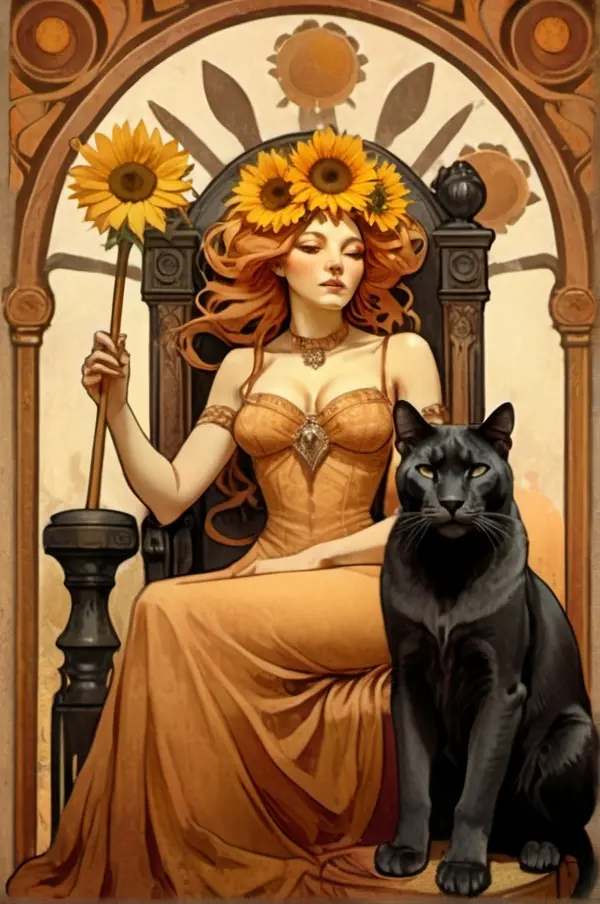
Slow tarot: Queen of Wands
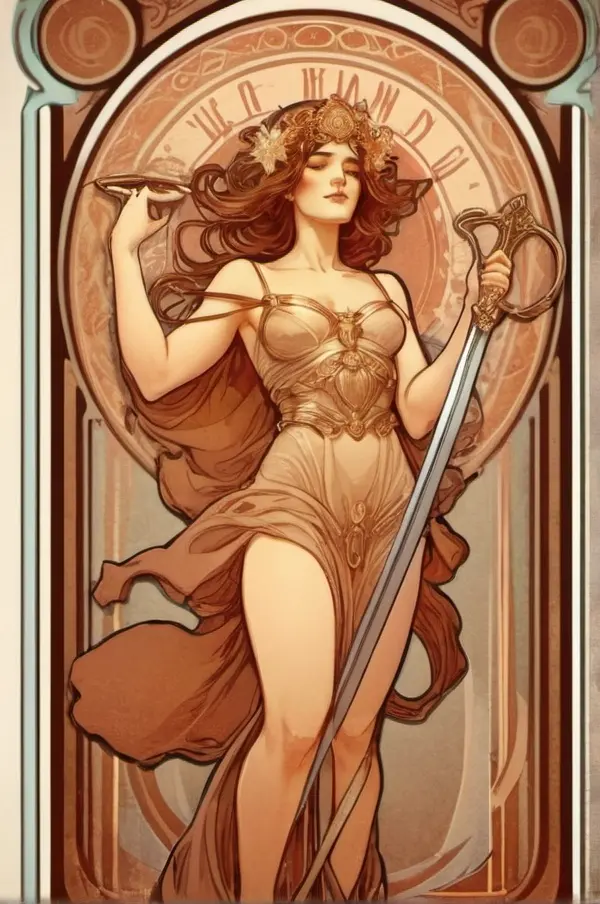
Use the Queen of Wands above, or pull your own copy from your deck. Sit with the image before you name her.
What do you actually notice? For example:
- how she sits or stands, and what she is holding (wand, staff, flower, whatever the artist put there)
- her hair, crown, or headdress, and whether something in it frames her face
- small animals, people, or objects at the sides or in front of her
- the setting: throne room, garden, heat, sky, and where her eyes go
- whether her body reads as warm, direct, regal, or like she is owning the space
No textbook required. You are just looking. Your list should fit your deck, not a script copied from a website.
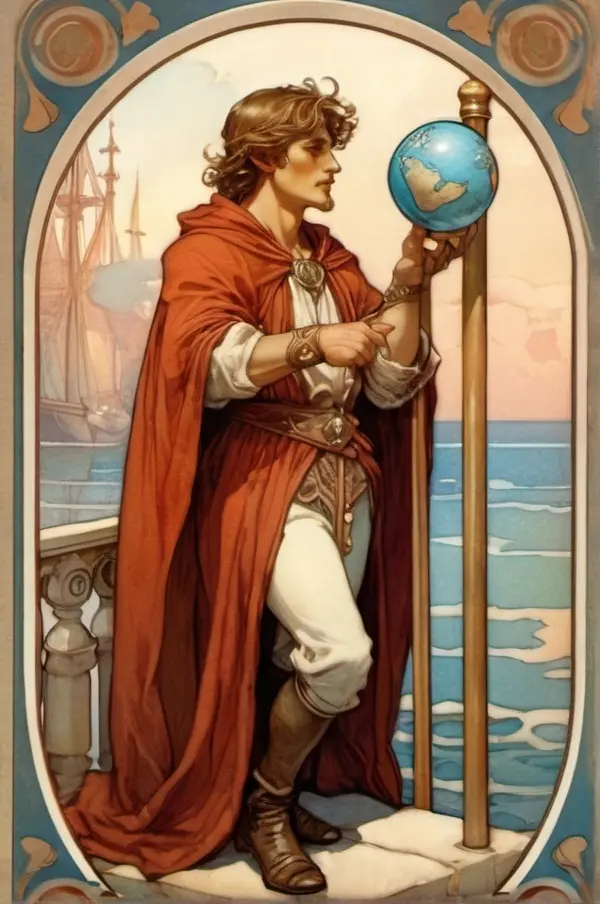
Slow tarot: Two of Wands
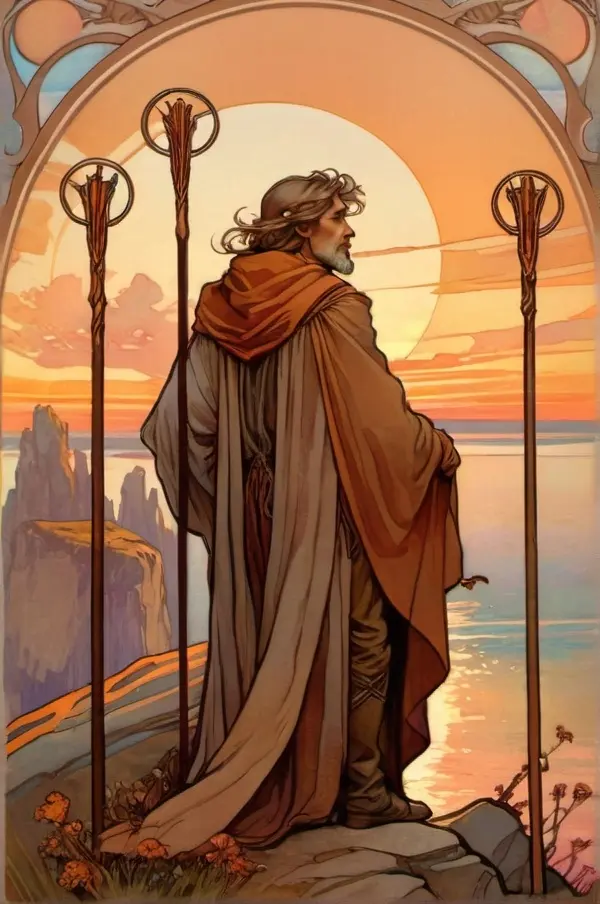
Do the same with the Two of Wands. You might spot:
- a figure who feels older or more "settled" in how they are drawn
- maps, open land, or empty space that reads like distance or a fork in the road
- something that points the way: a wand, a globe, a railing toward the horizon
- sea, buildings, or sky that whisper "somewhere else"
- a mood of planning a move, not just standing still
Update the list with what you see. From there it gets easier: one card holds space, the other aims at a direction. The connection shows up in the pictures, not in a rush to be right.
Intuition, anxiety, and wishful thinking are not the same thing
This is where most people get stuck, and it is a fair worry. How do you know the flutter in your chest is intuition and not just nerves telling you what you already feared, or hope telling you what you want to hear?
A few honest checks:
Intuition is usually quiet and specific. It sounds like "the two figures are turned away from each other," not "this is bad" repeated on a loop. Anxiety is loud and general. Intuition names a detail.
Wishful thinking reaches for the best-case label fast. You see the Ten of Cups and immediately think "wedding, forever, done." Real intuitive reading stays with the picture a beat longer and asks what is actually happening in it, not just what title would feel good.
Intuition can sit next to discomfort. If a read makes you want to re-shuffle until you get a nicer card, that urge is information on its own. A genuine read does not need to flatter you to be useful.
Check it against what you already know. Real intuition connects to something true you can name: a pattern in his texting, a fact about the job. If the "insight" only exists inside the reading and contradicts everything you have observed in real life, treat it as a hypothesis, not a verdict.
None of this makes tarot a lie detector. It is a mirror and a prompt, not a guarantee about the future. Compare what the cards showed you with how people actually behave over the next few days. That habit sharpens intuitive reading faster than any course.
Three more worked examples
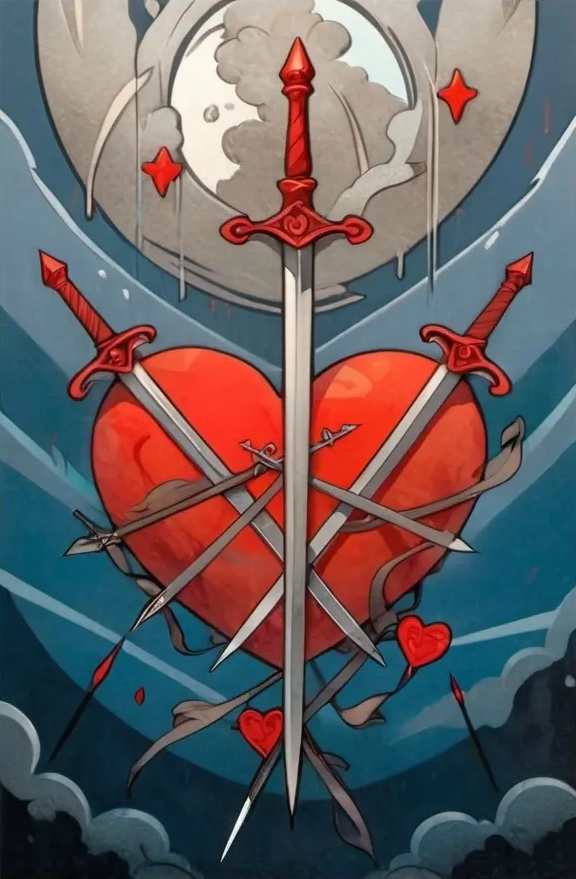
Three of Swords. The obvious keyword is heartbreak, and it is not wrong. But look first: how many swords, at what angle, and what is the sky doing? A gray, rainy backdrop reads differently from a stark, empty one. That detail matters if your question is about the size of the pain, not just its presence.
Ten of Cups. This one tempts the wishful-thinking trap harder than most cards. Before you land on "happy ending," look at the figures. Are they facing each other or turned toward the cups overhead? A scene that looks posed and distant points to an idea of happiness rather than a lived one. Figures touching and looking at each other tend to read as more grounded.

Eight of Cups. A figure walks away from eight stacked cups toward mountains, under a moon or an eclipsed sun. Resist "leaving a bad situation" as your opening line. Look at the posture first: hunched, resolute, hesitant? Are the cups stacked neatly, as if something was completed, or scattered, as if something broke? That detail decides whether the card reads as a clean choice or a harder, unfinished kind of leaving.
Think of each card as one comic panel
One card, one frame. You are not decoding a cipher. You are noticing what is happening in the scene: who faces whom, what is close and what is far, what the weather and the bodies are doing.
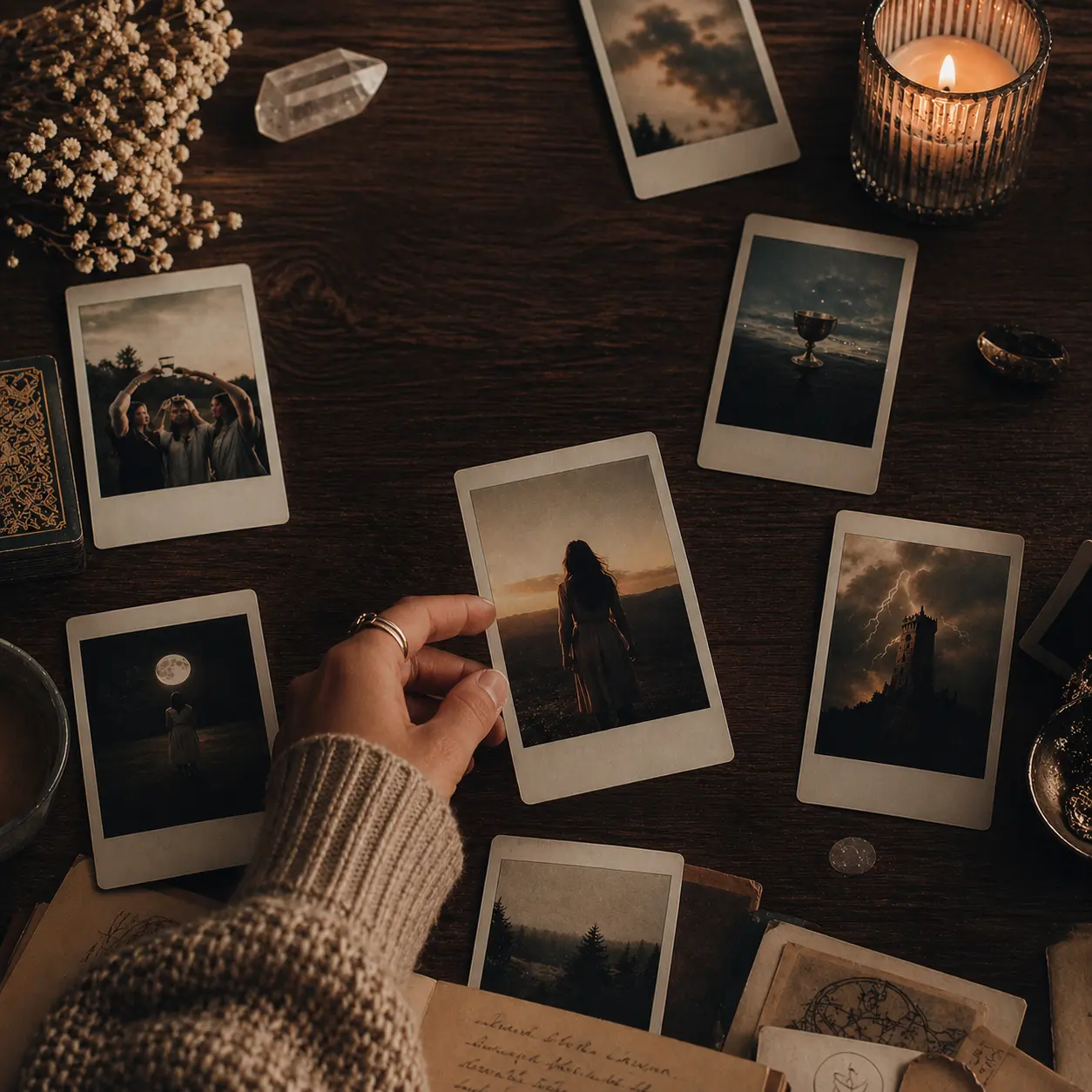
From the outside, tarot does not have to look mystical. It is closer to spreading out photographs until a story snaps into place, the way you sort prints for an album. Someone once described a reader "seeing" a person at a table, arranging photographs into an order. That is closer to how intuitive tarot reading actually works than most people expect.
Exercises to build the skill over time
Reading intuitively is a trained habit, not a fixed trait. These exercises build it in small, repeatable doses.
One card, no book, thirty seconds. Every morning for two weeks, pull one card and write three sentences describing the image only.
Silent readings. Pull three cards for a real question but stay silent for a full minute. Only after that minute, say what you noticed and what you think it means.
Blind compare. Once a week, write your intuitive read of a card, then check the traditional meaning and note where they agree and where they split.
Describe for a friend. Pull a card and describe it to someone as if they cannot see it. This forces plain, specific language instead of borrowed jargon.
Track outcomes. For any card pulled about a real situation, write one line a few days later about what actually happened. This is the fastest way to learn the difference between your intuition and your hopes.
A one card tarot reading is the easiest format for all five of these, and a running tarot card of the day practice turns the habit into muscle memory instead of a one-time experiment.
When to check the keyword meaning (and when not to)
Keyword meanings are not the enemy here. Skipping straight to them is. Once you have described the image, named your first feeling, and written your own read, checking the traditional meaning is useful for a few reasons: it catches symbols you might not recognize yet, it gives you shared language when you read for other people, and it can confirm a hunch you were not fully trusting.
The guides on tarot card meanings and reversed tarot cards meaning are good places to check your notes once the looking is done. Read them after you write your own description, not instead of it. If you are still working out the basics of shuffling, framing a question, or picking a first spread, how to read tarot cards covers that ground in more detail.
If readings have felt thin or forced
Maybe a spread fell flat, for you or for someone else. Maybe you talked yourself into a corner, or wondered whether you "have enough intuition" for this. Nothing was missing. You probably started one beat too late.
So: pull a card. Look at the art. Say it out loud or write it down. Then read it. In the TarotGo app, take the same five seconds with the card image open before you tap through to the meaning, the habit works just as well on a screen as it does with paper cards.
A lot of the time, the gap between "guessing" and "reading tarot intuitively" is just where you chose to begin.